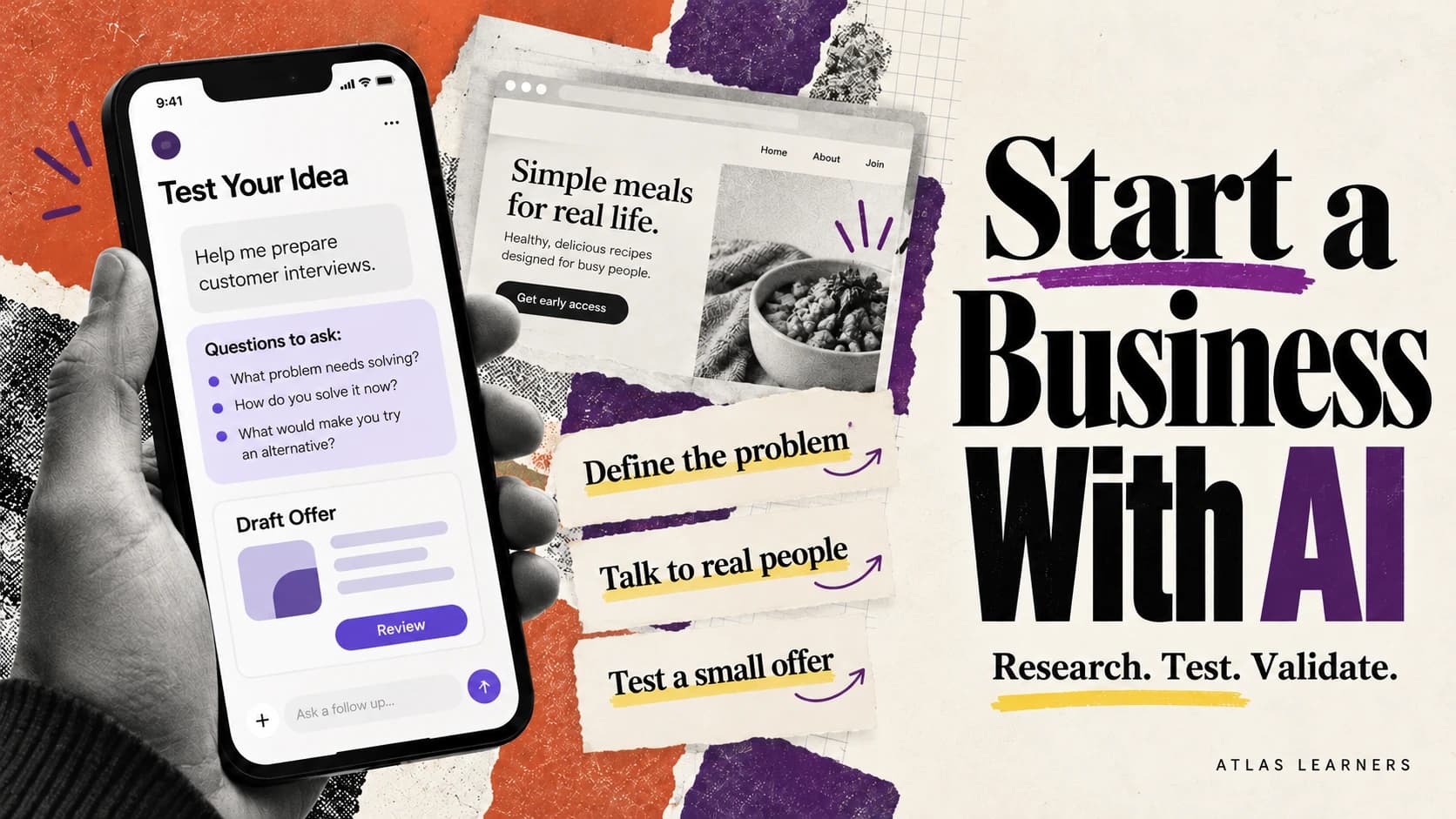
Learning how to use AI to start a business means using it to prepare research, organize evidence, compare options, and draft materials you can check. AI can support the work, but real customers, current sources, and the work you can actually deliver must determine whether an idea deserves investment.
Start with one customer problem and one small test. The nine uses below help you move from an uncertain idea toward a more informed decision. Atlas Learners’ generative AI guide explains the limits behind this approach.
Real business results also call for care. A field experiment with Kenyan entrepreneurs, published in 2026, found no clear average gain in revenue or profit from access to an AI adviser. The lower-performing group did nearly 10% worse with access to the adviser. This does not predict your startup’s outcome, but it is a reason to check advice against customer evidence and your own costs.
Use AI to Prepare Decisions
AI is useful when the result is a draft, a structured comparison, or a question to investigate. It is less useful as a substitute for evidence that someone has the problem, will pay for a solution, and can be served at a workable cost.
AI Can Help Prepare |
Evidence You Still Need |
Your Decision |
|---|---|---|
Customer interview questions |
Actual customer experiences and behavior |
Which problem to investigate |
Competitor comparison |
Current offers and terms from original sources |
How your offer differs |
Cost worksheet |
Your time, supplier quotes, and operating costs |
Whether the offer is viable |
Launch messages |
Approved facts and a clear service scope |
What you can responsibly promise |
The U.S. Small Business Administration’s planning guidance combines market research, direct customer research, business planning, and startup costs. Those categories are useful beyond the United States, while local registration, tax, and legal requirements need local sources.
Nine Practical Pre-Launch Uses
Choose the use case that addresses your biggest uncertainty. Producing more marketing copy is not the next step if you have not established what customers need.
1. Turn a Broad Idea Into a Specific Problem
Ask AI to help describe who has the problem, when it happens, and what they do now. These are ideas to check with people, not facts about your market.
Help narrow this business idea: [idea]. List possible customer groups, the specific task each struggles with, and the evidence needed to confirm the problem. Do not invent customer quotes or market demand. Recommend one group to investigate first based on the information I provide.
The useful output is a focused research question. A confident description of a customer does not mean that customer exists in sufficient numbers or wants your offer.
2. Organize Research From Published Sources
Use AI to structure information from sources you have opened, such as official statistics, trade bodies, and competitors’ public pages. Keep the source, date, geography, and definition beside each claim.
Ask for a table that separates observed facts from interpretation. If a statistic describes all small businesses in one country, do not silently use it as the size of your local customer segment. A large market total can be irrelevant to a narrowly defined service.
3. Draft Better Customer Interview Questions
AI can help replace leading questions with questions about actual experience. “Would you buy my useful service?” invites a polite answer. “How did you handle this task last time?” produces a more concrete starting point.
Draft 6 interview questions about [problem]. Ask about the last time it happened, the current workaround, costs or effort, and what would trigger a change. Avoid pitching my idea or asking the person to predict a purchase.
You still need to conduct the interviews. A chatbot role-playing a customer can help you rehearse, but its answers are not customer research.
4. Compare Competitors on the Same Criteria
Give AI verified descriptions of a few relevant alternatives. Compare the audience, offer, pricing basis, delivery time, exclusions, and evidence of service quality using the same fields.
Include the option of doing nothing or handling the task internally. Your competition may be a spreadsheet and an existing employee rather than another startup.
Preserve “not stated” where information is missing. Before using a price, check its currency, billing period, required extras, and date. Do not fill a comparison table with guessed figures merely to make every cell look complete.
5. Explore Offer Variants
Ask for two or three clearly limited versions of an offer, then choose according to what you can deliver and what the interviews reveal. For a houseplant-care service, the variants might be a one-time holiday visit, a recurring check, or a care-plan consultation.
Compare the deliverable, customer involvement, turnaround, and exclusions. A narrow offer can be easier to test because both sides understand what is included.
Use Atlas Learners’ prompting framework to keep these constraints explicit. OpenAI’s prompting documentation also explains supplying relevant information and output requirements. AI-generated business ideas become more useful when they are tied to evidence and capacity rather than novelty alone.
6. Build a Simple Cost Worksheet
Use AI to list cost categories and suggest formulas, then enter verified values yourself. Separate setup costs, recurring costs, and costs that increase with each job.
In a hypothetical service, three hours valued at 20 currency units per hour plus 10 units of direct costs equals 70 units per job before other overhead. That is a calculation from assumptions, not a market price or proof of profitability.
Ask what the worksheet excludes: finding customers, revisions, taxes, payment fees, travel, or unused capacity may matter. Check the arithmetic independently before using the result to choose a price. For repeated calculations, the Atlas AI task guide offers related workflow ideas.
7. Create a Small Launch Plan
Ask AI to sequence the work needed for a limited test: define the offer, prepare a sample, contact appropriate prospects, deliver the pilot, and review what happened.
Build a two-week test plan for [offer] with [available hours] and [budget]. List what must happen first and which decisions I need to make. Keep the scope to one customer group and one way to reach them. Separate tasks I can do now from tasks that need evidence or approval.
Check the plan against your actual availability. A schedule that assumes a finished website, confirmed supplier, or customer list you do not have is not ready to use.
8. Draft Clear Customer Messages
AI tools for entrepreneurs can help turn an approved offer into a landing-page draft, an introductory email, or a short service description. Supply facts about what is included, the audience, price if confirmed, and the next step.
Review every promise. Remove invented testimonials, unsupported savings, and claims that your service is “best” without evidence. Keep customer-facing language specific enough that someone can understand the scope before responding.
This is a practical use of generative AI for business because you can compare the draft directly with the approved offer.
9. Prepare Responses to Early Inquiries
Collect common questions and draft answers from your actual terms. Keep unanswered questions in a separate list rather than letting AI decide policy.
When using AI for small business tasks, a draft you review yourself is often enough at this stage. Keep control of messages, discounts, refunds, and promises until you have clear rules for checking and approving them.
OpenAI’s guidance on using ChatGPT describes supplying relevant files and tools as context. Whatever assistant you use, give it only the information it needs and inspect the resulting message before sending it.

A Hypothetical Service Idea From Assumption to Test
Suppose you want to offer houseplant care to people traveling away from home. You can spend six hours weekly on the project. Your fictional interview notes say:
- Person A worries about overwatering while away and wants someone to follow the care instructions for each plant.
- Person B already has a neighbor who helps and does not want another service.
- Person C wants help but will not give a new provider unsupervised access to the apartment.
Ask AI:
Use only these interview notes. Separate observed statements, possible interpretations, and unanswered questions. Suggest one small offer to test within six hours weekly. Do not claim the interviews prove demand or invent willingness to pay.
A weak response might recommend launching a monthly service immediately because “two of three customers are interested.” That overstates the evidence: the notes contain no purchase commitments, the people are not established customers, and Person C has an unresolved home-access concern.
Revise the recommendation to a smaller test: demonstrate a plant-care checklist, show it to an appropriate prospect, and ask whether a defined paid trial visit would solve the problem. Agree how entry, care instructions, visit length, price, and responsibility for damage would work before accepting a booking.
Validate With Real People
Keep a worksheet linking assumptions to evidence. It helps you see whether each activity reduces uncertainty or merely produces more documents.
Assumption |
Current Evidence |
Next Test |
|---|---|---|
Travel creates a plant-care problem |
One fictional interview describes it |
Ask other travelers how they handled plant care on their last trip |
A traveler will pay for help |
Not established |
Present a bounded paid pilot offer |
Home access can be arranged acceptably |
One home-access concern |
Agree an entry method before any booking |
Delivery fits available capacity |
Six hours weekly available |
Time a demonstration visit and include travel and checks |
A few interviews can uncover objections worth investigating. However, they cannot tell you what percentage of the whole market would buy. Use them to improve the offer and decide what to test next.
Look for evidence against your preferred idea too. A current workaround may be good enough, or the person experiencing the problem may not control the budget. Those findings can save you from building the wrong offer.
Protect Information and Check Commitments
Use fictional data for early experiments. For real customer material, confirm permission, approved tools, necessary fields, and who can access the output.
Review the provider’s current data terms. ChatGPT’s data controls, for example, separate training settings from other account and retention controls. A privacy setting does not override a customer agreement or your organization’s rules.
For each AI-assisted task, name the possible mistake, who will check it, and which action must wait for approval. Get qualified local advice for legal, tax, or other regulated decisions.

How to Use AI to Start a Business With a Small Test
Choose your most important unproven assumption. Use AI to prepare one interview, comparison, or small demonstration, then collect evidence outside the chat.
This is a practical way to learn how to use AI to start a business: write the offer, discuss the problem with a potential customer, and record what changed in your plan before paying for a broader launch.