

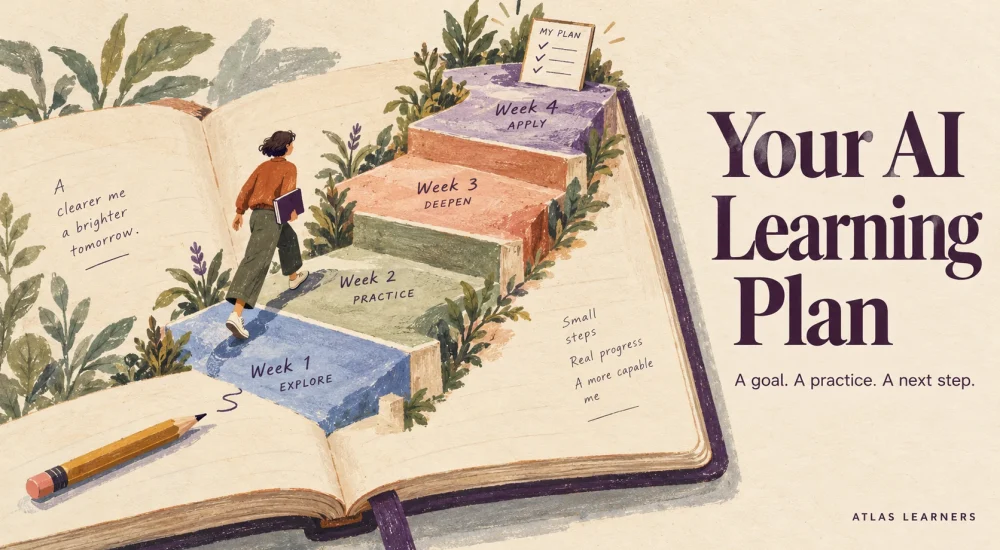
An AI personal learning plan should turn one clear goal into practice you can fit into your week and check through finished work. Give AI your starting point, available time, resources, and success criteria, then revise its schedule before following it.
The example below builds a four-week plan for producing a household expense report. The schedule is hypothetical and adjustable; it is not a promise of mastery in four weeks. If you are new to briefing an assistant, Atlas Learners’ prompting guide provides a useful starting structure.
Define the Work You Want to Do
Describe a task you want to complete, rather than a subject you want to “know.” A goal such as “learn spreadsheets” can expand indefinitely. “Group one month of household expenses by category, create a chart, and explain the largest costs” gives the plan a destination.
For this report, a successful result keeps the original transactions, separates transfers from spending, uses consistent categories, and checks category totals against the included transactions. It should also explain one limit of the report.
Carnegie Mellon’s learning-objective guidance focuses on work a learner can show. The same principle makes an AI learning roadmap easier to judge: both you and the assistant can see what the practice is meant to produce.
Write your goal in this form:
By [review date], I want to produce [specific work] using [tools or conditions]. The work must meet [checks]. I will demonstrate this on a new example with [allowed assistance].
Check Your Starting Point
Try a small version of the task before asking for a full schedule. That attempt shows which basics you need to learn, rather than relying on a broad “beginner” label.
For the expense-report example, use a fictional month of purchases, transfers, and refunds. Try to assign categories, calculate category totals, and explain why a transfer between your own accounts should not be counted as new spending. Note which steps you can do alone and which you cannot yet explain.
You might know how to make a chart but not how to choose its source range. Someone else may understand the calculation but struggle to write a clear summary. Those learners need different practice even if both describe themselves as beginners.
Ask AI to help interpret the evidence without guessing what you know:
Here is my goal and my baseline attempt: [details]. Identify the skills this task requires. Separate gaps demonstrated by my work from skills this attempt did not test. Suggest one short check for each basic skill you are unsure about.
Set Up Your AI Personal Learning Plan
A useful AI study planner must respect the time you can reliably use. Count practice, checking, and revision as part of that budget, rather than treating them as free additions after the lessons.
Suppose you have four 30-minute sessions a week. That gives you 120 minutes weekly and eight hours over four weeks. Build the plan around that time, then adjust it after seeing what you can finish.
Use a brief like this:
Build an AI personal learning plan for producing a household expense report. I can sort rows and use SUM, but I need practice with transaction categories, transfers, refunds, charts, and concise explanations. I have four 30-minute sessions weekly for four weeks. Use fictional transactions. Include explanation, hands-on practice, source checking, and an independent attempt. Show minutes per session, skills needed beforehand, one weekly output, and a review rule. Do not assume I can buy software or access a paid course.
Add constraints that change the plan: a shared computer, accessibility needs, unreliable internet, or a work schedule that shifts. Specific constraints are more useful than asking the assistant to make the plan “personalized.”
Build a Four-Week Practice Schedule
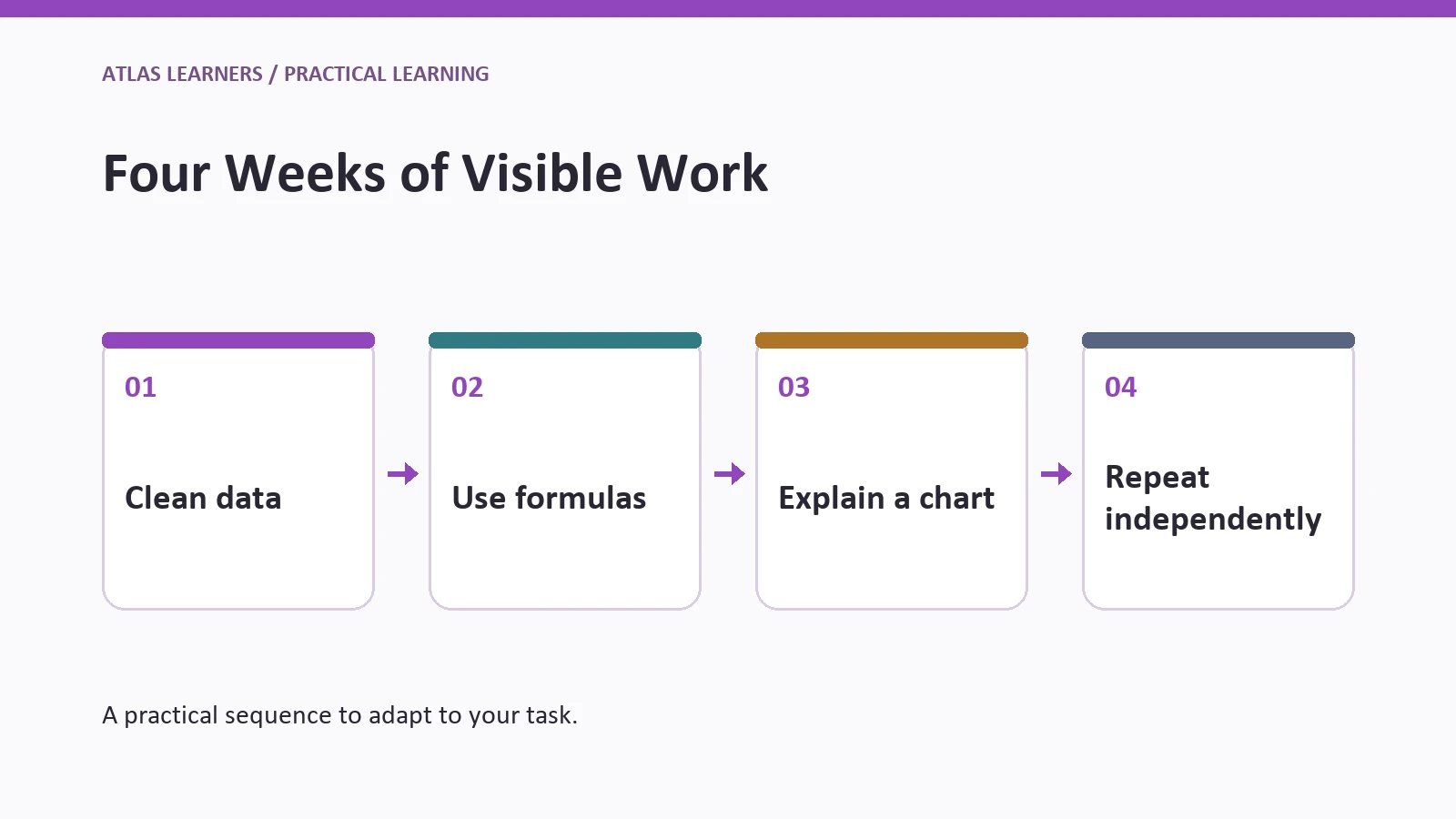
Each week should produce visible work. A list of topics is not enough to tell you whether the plan is working.
|
Week |
Main Focus |
Output and Check |
|---|---|---|
|
1 |
Structure and clean a small table |
Cleaned copy plus a log explaining each change |
|
2 |
Calculate category totals |
Formula sheet with independently checked results |
|
3 |
Choose and explain a chart |
Labeled chart and a paragraph that matches its scope |
|
4 |
Complete a new example |
A checked report with less assistance and an error log |
Within a typical week, use the first session for a short explanation and guided attempt, the second for hands-on practice, the third for checking and correction, and the fourth for a fresh attempt. Change the balance when your baseline shows you need more work on one step.
For example, split a 30-minute calculation session into five minutes recalling the formula, 15 minutes using it, and 10 minutes checking and explaining the result. If checking takes longer, shorten the exercise rather than skip the check.
Add Review Without Crowding Out Practice
Revisit earlier material on later days, and make some of that review an attempt from memory. A plan that repeatedly introduces new topics can leave little time to retain or connect them.
The IES practice guide recommends spacing learning over time. The Dunlosky review also supports practice testing and distributed practice across many learning contexts. Neither source establishes a single optimal AI-generated schedule for your goal.
Keep review small and responsive. At the beginning of week 3, rebuild one category total from week 2 without looking at the formula. If you cannot explain why a transfer was excluded or how a refund was treated, revisit that decision before adding a more complicated chart.
You can ask ChatGPT Study Mode to question you or guide a practice attempt when available. For a practical skill, also work in the actual tool: a conversation about spreadsheets does not demonstrate that you can operate one.
A Hypothetical Plan That Needs Revision
Imagine the assistant proposes four 30-minute lessons each week, then adds a 45-minute project and a 20-minute review. The schedule looks organized, but it requires 185 minutes rather than the available 120.
It also spends the full original allowance on instruction. You would reach the end of the week without time to practice, correct mistakes, or attempt the task independently.
The review should therefore change both the time and the activity mix. Remove a lesson that is not required for the immediate output. Use a shorter explanation of the remaining concept, followed by a practice task and a check.
Revise this plan to fit exactly four sessions of no more than 30 minutes each. Include all practice and review within those sessions. Remove optional content before cutting the independent attempt. Explain which learning goal each session supports and list anything postponed.
A revised week might cover cleaning rules on Monday, a guided cleanup on Tuesday, error review on Thursday, and a new small table on Saturday. The final table provides evidence of progress; watching four lessons alone would not.
Measure Progress and Adjust the Next Week
Track what the work demonstrates. Hours spent and lessons completed are useful activity records, but they do not show whether you can produce a correct report.
Use a short log after each independent attempt:
|
Record |
Example Entry |
|---|---|
|
Task attempted |
Grouped a fictional month of household expenses |
|
Check passed |
Totals matched the source rows |
|
Error found |
Counted an internal transfer as new spending |
|
Correction |
Excluded the transfer from spending and reconciled the totals |
|
Next practice |
Repeat with a new transaction sheet containing a refund |
Carnegie Mellon’s assessment guidance connects the assessment to the intended skill. If your goal is to interpret a chart, ask for an explanation of a new chart rather than another quiz on chart names.
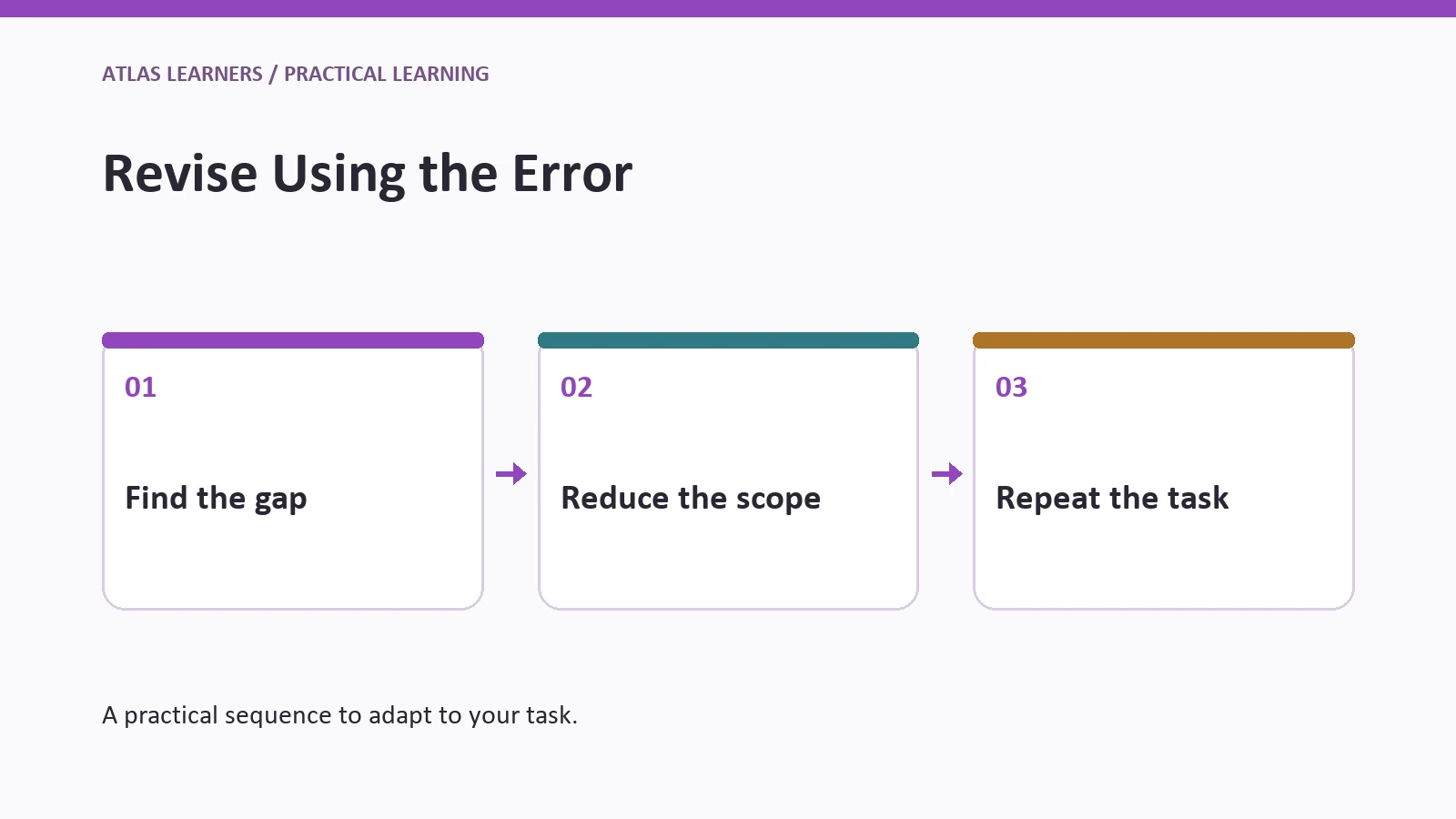
If you cannot explain an important choice, practice that step again. When you can complete it correctly, try with less help. If time runs short, postpone optional material before removing the practice that tests your goal.
Recover From a Missed Session
A missed session should trigger a smaller plan, not an unrealistic pile of extra work. Keep the next session focused on the skill needed for the weekly output.
Tell the assistant what happened and what remains possible:
I missed Tuesday’s session. I now have 60 minutes this week. My last attempt counted an internal transfer as spending, but I can organize the transactions correctly. Keep the transaction-classification exercise and one independent check. Postpone optional chart styling. Return two sessions of 30 minutes.
An AI study schedule becomes useful when it reflects the time you actually have. The assistant can rearrange activities, but you decide which work matters and whether it fits.
Choose Materials After the Plan
Choose resources that teach the skill you need. A broad course may be useful, but you do not need to complete every related topic before practicing one report.
Check a sample lesson, the skills you need before starting, the exercises, and feedback options. Check that any software required for the exercise is available to you. For wider AI concepts, use the Atlas generative AI guide; for recurring tasks, the AI workflow article offers practical starting points.
Practice with fictional information or data you have permission to use. Keep workplace data out of personal tools unless your organization allows it.
Book the First Practice Session
Start your AI personal learning plan with a small fictional transaction sheet. Save your first attempt and choose the next exercise from a mistake you find.
Put the first two practice sessions in your calendar. Later, compare your independent report with the first attempt: can you now explain the totals and avoid the same error?