

The most useful AI skills to learn first help you complete and check a task you already need to do. Learn what AI can and cannot do alongside clear writing, subject knowledge, and basic data skills. Together, these help you judge whether an answer is usable.
For most nontechnical learners, the starting point is a small work sample rather than a long list of tools. Identify where you struggle, practice that capability, and add AI where you can review its contribution. Atlas Learners’ introduction to generative AI explains the underlying concepts if they are new to you.
AI and Traditional Skills Work Together
AI skills and traditional skills support different parts of the same task. Understanding a problem helps you explain it clearly to AI. Similarly, checking an AI-generated chart requires enough comfort with numbers to question the result.
|
Work You Need to Do |
AI Skill |
Supporting Skill |
|---|---|---|
|
Prepare a report |
Supply relevant data and request a useful structure |
Interpret numbers and explain implications |
|
Reply to a customer |
Draft from approved facts and constraints |
Listen, judge tone, and make accurate commitments |
|
Research a decision |
Organize sources and expose missing evidence |
Evaluate sources and distinguish fact from inference |
|
Improve a process |
Identify a clearly defined step AI could assist |
Understand the workflow and its failure points |
The World Economic Forum’s Future of Jobs Report 2025 found that about 7 in 10 surveyed employers considered analytical thinking a core skill. Employers also expected AI and big data to lead skill growth. These are employer priorities and expectations, not evidence that a particular course improves performance.
A field experiment with 758 consultants shows why checking matters. On tasks suited to the GPT-4 system studied, AI users completed 12.2% more tasks and worked 25.1% faster on average. However, they were less likely to solve a separate complex task correctly. The study, published in 2026, supports learning when to use AI and how to check it; it does not predict your speed with a current tool.
Which AI Skills to Learn First
Start by choosing a suitable task, writing a clear brief, supplying relevant sources, and checking the answer. These habits remain useful when you switch tools or a familiar menu changes.
Choose a Task You Can Check
Good starting tasks have clear inputs and results you can check. For example, you can compare a summary with the approved notes it came from. Judging an unfamiliar business strategy is much harder.
Pick one task from the Atlas guide to everyday AI workflows. Write down what a correct result must contain and what would make it unusable before running the prompt.
Give AI a Useful Brief
A brief should identify the task, audience, source material, constraints, and expected output. “Write a report” leaves too many decisions open. “Summarize these five updates for the project lead, separating confirmed progress from unresolved blockers” gives a more usable direction.
Use the four-part prompt structure as a starting point. The skill is expressing your actual need, not collecting elaborate role-playing phrases.
Select and Check the Information
Supply material that is relevant, current, and permitted for the task. Ask the assistant to flag missing information, then check those gaps yourself.
Checking answers is part of understanding AI. Look for the wrong number used in a calculation, a claim without support, a missed exception, or a reply that avoids the question. UNESCO’s student framework also covers human judgment and ethics alongside technical skills.
Use a Work Sample to Find the Gap
Your next learning priority should come from a task you attempt, not only from a self-rating. Confidence can miss gaps that become obvious in a finished piece of work.
Choose a small, public or fictional example: a one-page update, a spreadsheet summary, or a reply based on a short policy. Complete an initial version without AI, then use AI to help revise it. Compare the two against the same criteria.
|
Criterion |
Evidence to Look For |
If It Is Missing |
|---|---|---|
|
Task understanding |
The output answers the actual request |
Practice framing the problem |
|
Source handling |
Claims trace to the supplied material |
Practice selecting and checking evidence |
|
Accuracy |
Numbers, names, and conditions are correct |
Strengthen subject knowledge or basic number skills |
|
Communication |
A reader can identify the result and next step |
Practice explaining and editing |
For each item, record “independent,” “needs help,” or “not yet demonstrated.” Use this practice record to choose your next exercise; it is not a hiring score.
Carnegie Mellon’s guidance on learning objectives supports describing what a learner should be able to do. “Produce a checked weekly update” is therefore a more useful target than “become good at AI.”
Choose Your Starting Point
The right order depends on the gap in your work sample, but the decision can still be specific.
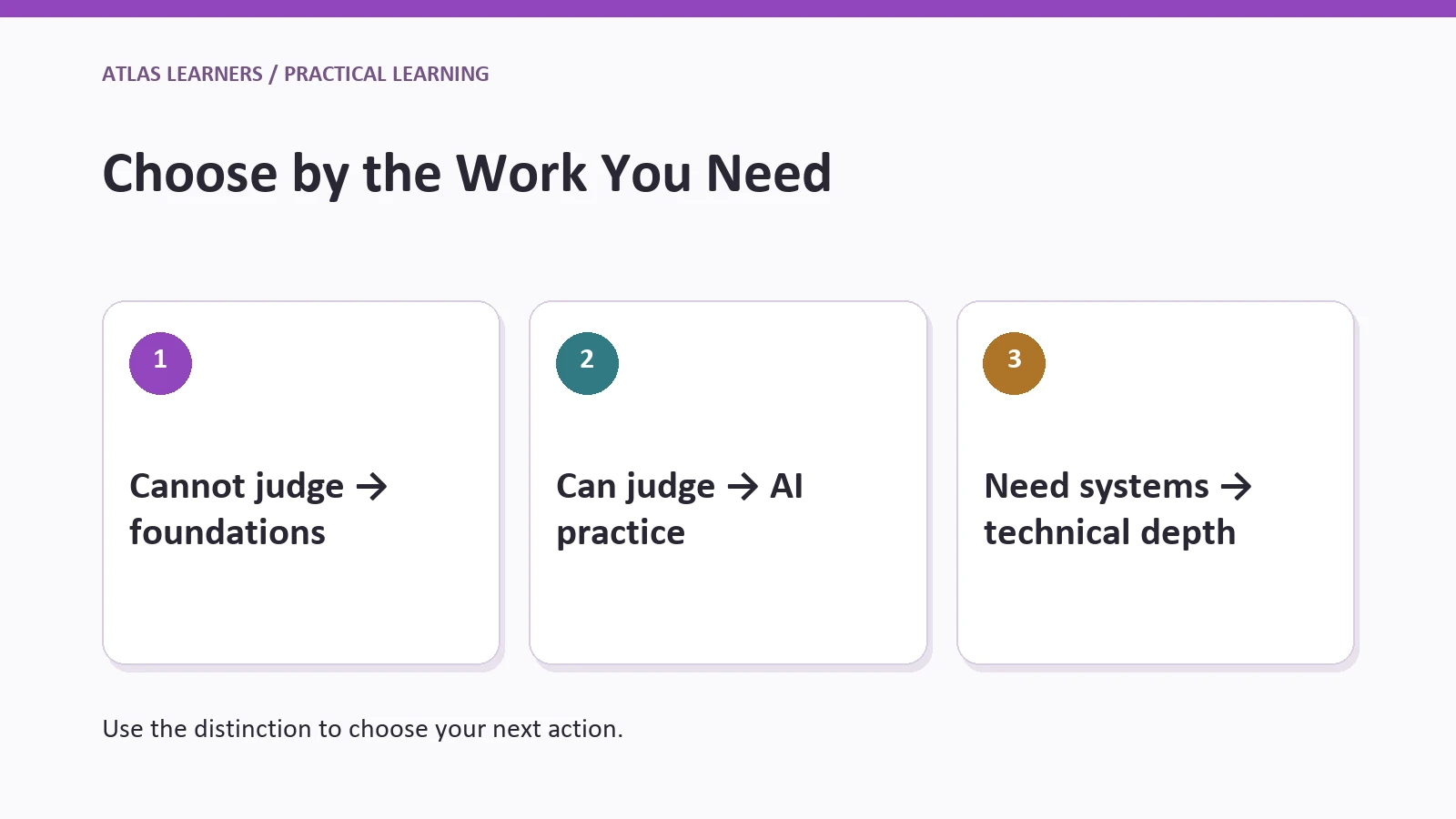
If You Are New to the Task
Learn the task’s basic concepts first while using AI for explanations and low-risk practice. A beginner who does not understand percentages needs that foundation before trusting an AI-generated performance comparison.
You can still explore the tool. Ask it to explain a simple example, then solve another one independently. Keep the work small enough that you can check it with a reliable reference.
If You Know the Work but Are New to AI
Start with clear briefs and careful checking. Your subject knowledge helps you see whether a draft keeps the facts straight and meets the task’s requirements.
Use one familiar workflow repeatedly. Record which instructions improved the result and which problems remained. That builds a reusable method instead of a collection of unrelated demonstrations.
If Your Goal Is a Technical Role
Add the technical prerequisites the role actually requires. Programming, statistics, databases, or system design may matter more than another general prompting lesson.
Read a small set of relevant job descriptions and inspect the work behind the terminology. A data role and an AI application development role may both mention AI, but their practical requirements differ. Broad lists of in-demand digital skills cannot settle that choice for you.
A Hypothetical Customer Reply Review
Consider a support coordinator replying to a damaged-delivery complaint. The approved facts say a replacement can ship after the customer confirms the order number. They do not authorize a refund or promise a delivery date.
The coordinator gives AI this prompt:
Draft a concise, considerate reply to a customer whose item arrived damaged. Ask for the order number so we can arrange a replacement. Use only the supplied facts. Do not promise a refund or a delivery date.
Suppose the first draft says, “We have refunded your payment, and your replacement will arrive tomorrow.” The tone sounds helpful, but neither commitment is supported. The coordinator must recognize the policy error before polishing the wording.
A checked revision reads: “I’m sorry your item arrived damaged. Please send your order number so we can arrange a replacement. We’ll confirm the shipping details after checking the order.” It acknowledges the problem and gives a next step without inventing an outcome.
The error changes the learning priority. If the coordinator cannot spot the unsupported commitments, policy knowledge and source checking come first. If the facts are correct but the reply sounds dismissive or hides the next step, communication is the more immediate need. More elaborate prompting cannot replace either skill.
Practice a Pair of Skills
Choose one AI capability and one supporting capability for the same task. For example, pair AI-assisted summaries with accurate source reading, or AI-generated formulas with spreadsheet checking.
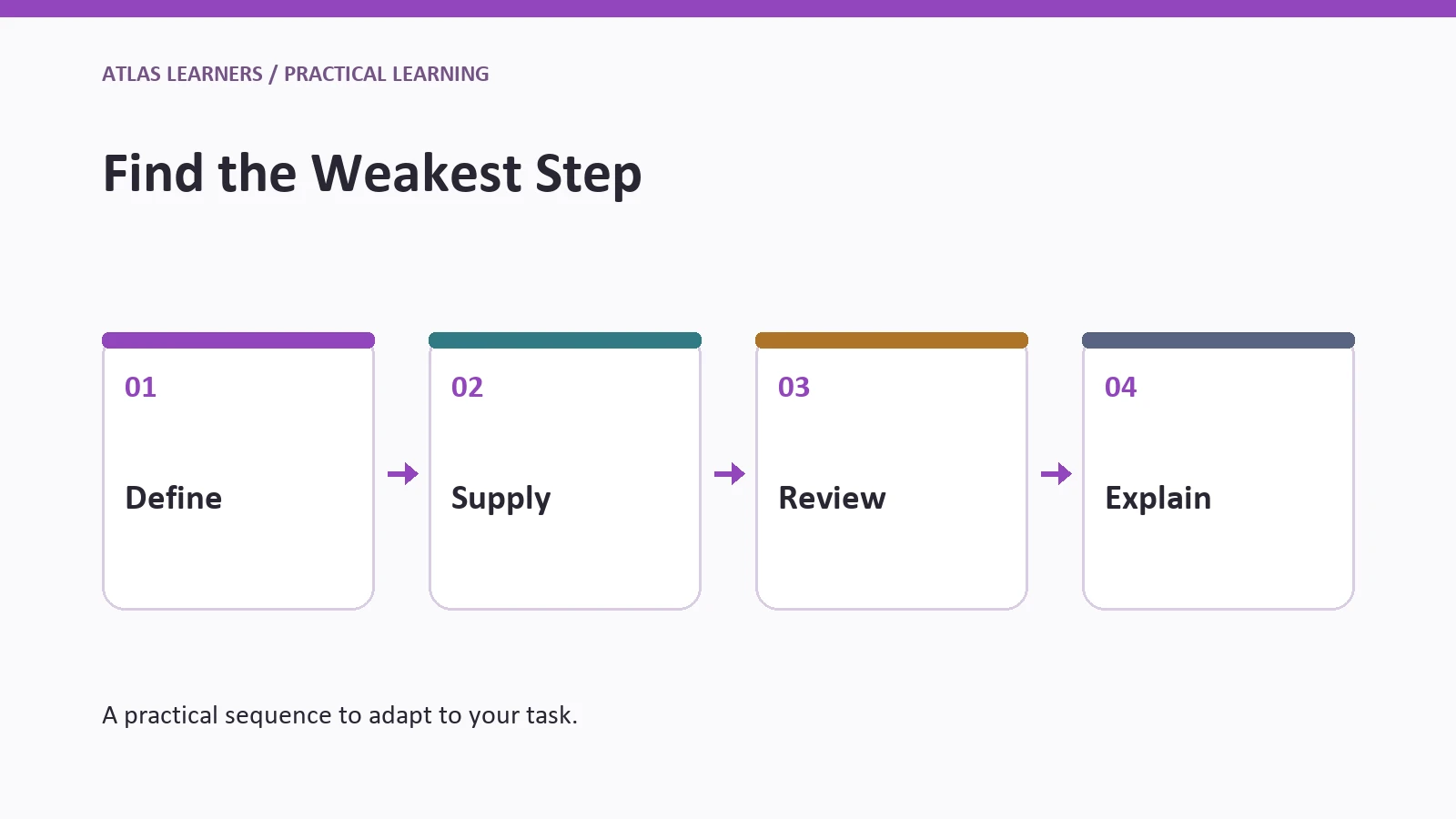
A short practice sequence can work like this:
- Define the output and the checks it must pass.
- Make an initial attempt using approved or fictional material.
- Ask AI for help with one specific weakness.
- Review the output against the original source.
- Repeat a similar task with less assistance.
A polished AI-assisted result does not show what you can do alone. For example, explaining how a formula works reveals more than recognizing its name in a quiz.
Keep a Small Evidence Log
Track the output, the defect you found, the correction, and what you can now do without help. This is more informative than counting prompts or hours watched.
For the support reply, an entry might read: “Removed an unauthorized refund and delivery promise; checked the replacement policy; made the request for an order number clear.” That record identifies a specific skill to practice in the next response.
Use approved tools and leave sensitive information out unless you have permission to share it. For work that affects customers, money, or other people, name the person who will check the result before anyone acts on it.
Choose One Skill Pair This Week
Write one sentence: “I need to produce [output], and my weakest step is [capability].” Then choose an exercise that addresses that weakness and use AI only where you can review its contribution.
Choose the AI skills to learn next from the defect you found. Rewrite one response, check every commitment against its source, then handle a new complaint with less assistance. Keep both attempts so you can explain what improved.