


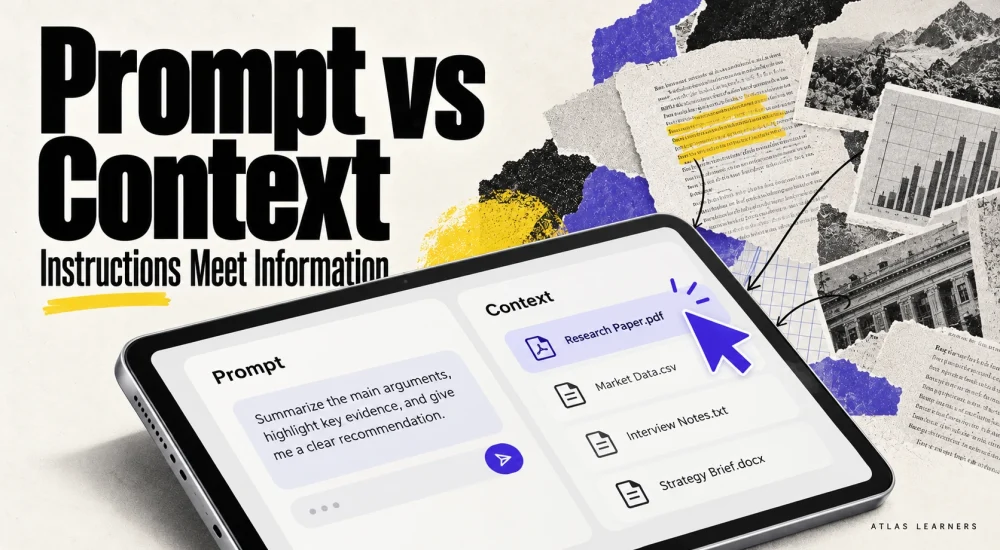
Prompt engineering vs context engineering comes down to two connected jobs: writing the instruction and choosing the information AI needs to follow it. Prompt engineering shapes what you ask and how you describe the result. Context engineering also covers the sources, examples, earlier messages, and tool results the system receives.
The two work together. If an answer uses the wrong format, improve the instruction. If it lacks a current policy or mixes conflicting records, improve the information and how it is selected. Atlas Learners’ prompting basics guide covers the instruction structure behind both.
The Difference at a Glance
Prompting is part of context engineering, rather than a competing technique that has become obsolete. Anthropic’s context engineering explanation uses the broader term for choosing and maintaining the information a model uses.
|
Question |
Prompt Engineering |
Context Engineering |
|---|---|---|
|
What do you change? |
Instructions, constraints, examples, output format |
The full set of relevant instructions and information |
|
Typical problem |
The answer is too long or misses the requested structure |
The answer lacks facts, uses stale records, or mixes sources |
|
Everyday action |
Request a 120-word reply with unanswered questions listed |
Supply the current policy and identify its effective date |
|
Repeated workflow |
Reuse a tested prompt template |
Keep sources, versions, access, and state current |
The boundary is not perfectly sharp. Adding an example to a prompt changes the context too. The distinction is useful because it helps you find the problem instead of repeatedly rewriting the same request.
What Prompt Engineering Changes
Prompt engineering means making the task clear. Specify who the answer is for, what to produce, which details to keep, and what the system must not assume.
For example, “Reply to this return inquiry” leaves the length, tone, source, and treatment of missing facts open. A stronger instruction requests a concise reply based only on an approved policy and requires unanswered questions to remain visible.
OpenAI’s prompting guidance describes clear instructions and relevant context, while Google’s prompt design guidance also discusses examples and iteration. These are design techniques, not guarantees that a model will follow every instruction or produce only correct statements.
Good AI prompt design also gives you something to check. “Be helpful” is hard to test. “State the return window, preserve the receipt requirement, and do not invent refund timing” provides specific checks.
What Context Engineering Adds
Context engineering asks what information should reach the model at each step. That might be a relevant paragraph from a current policy, a customer’s actual question, an earlier decision, or the result of a tool lookup.
It also asks what should stay out. An old policy can conflict with a new one. A long collection of unrelated files can make the relevant detail harder to use. Private information should not be included merely because it is available.
The LLM context window is the amount of information a language model can consider in a request. It is measured in tokens, which can be words, parts of words, or other small units. A larger window lets you supply more material, but the model can still miss or misuse a detail. For the basic terms, see Atlas Learners’ generative AI introduction.
You can apply context engineering without building software. Choose the right source, label its date and scope, and point out any conflicts. In larger systems, software can find relevant material and track what has happened during the task.
One Inquiry, Three Different Briefs
Consider a hypothetical store return policy. It says: “Unopened headphones can be returned within 30 days of delivery with a receipt. The customer must request a return label. Refund processing time is not stated.” A customer asks whether the headphones qualify and how soon the refund will arrive.
First Brief Without Useful Context
Write a friendly reply to someone asking whether they can return unopened headphones and how soon they will receive a refund.
This request gives the model no reliable basis for the details. A fluent reply could contain unsupported assumptions. The problem begins with missing information, not a lack of elegant wording.
Second Brief With Better Instructions
Write a friendly reply under 120 words. Answer the questions in order. Do not invent details; list anything that needs confirmation. Inquiry: “Can I return unopened headphones delivered two weeks ago, and when will I get my refund?”
The instruction is clearer, but the return policy is still absent. An appropriate response would ask for it or leave the terms unconfirmed. Rewriting “friendly” as “professional and welcoming” will not supply the eligibility rules.
Third Brief With the Relevant Source
Use only this approved return policy, version R2: unopened headphones can be returned within 30 days of delivery with a receipt; the customer must request a return label; refund processing time is not stated. Draft a reply under 120 words and identify anything needing confirmation. Inquiry: “Can I return unopened headphones delivered two weeks ago, and when will I get my refund?”
An illustrative reply is: “Your unopened headphones are within the 30-day return window. You will need a receipt and must request a return label. The policy does not specify refund processing time, so we need to confirm that before giving you a date.”
Check the answer against the policy. If a draft says “Refunds are processed immediately,” remove that promise. Eligibility for a return does not establish when payment will arrive. The source leaves that detail unresolved, so the reply must do the same.
Choose the Fix That Matches the Failure
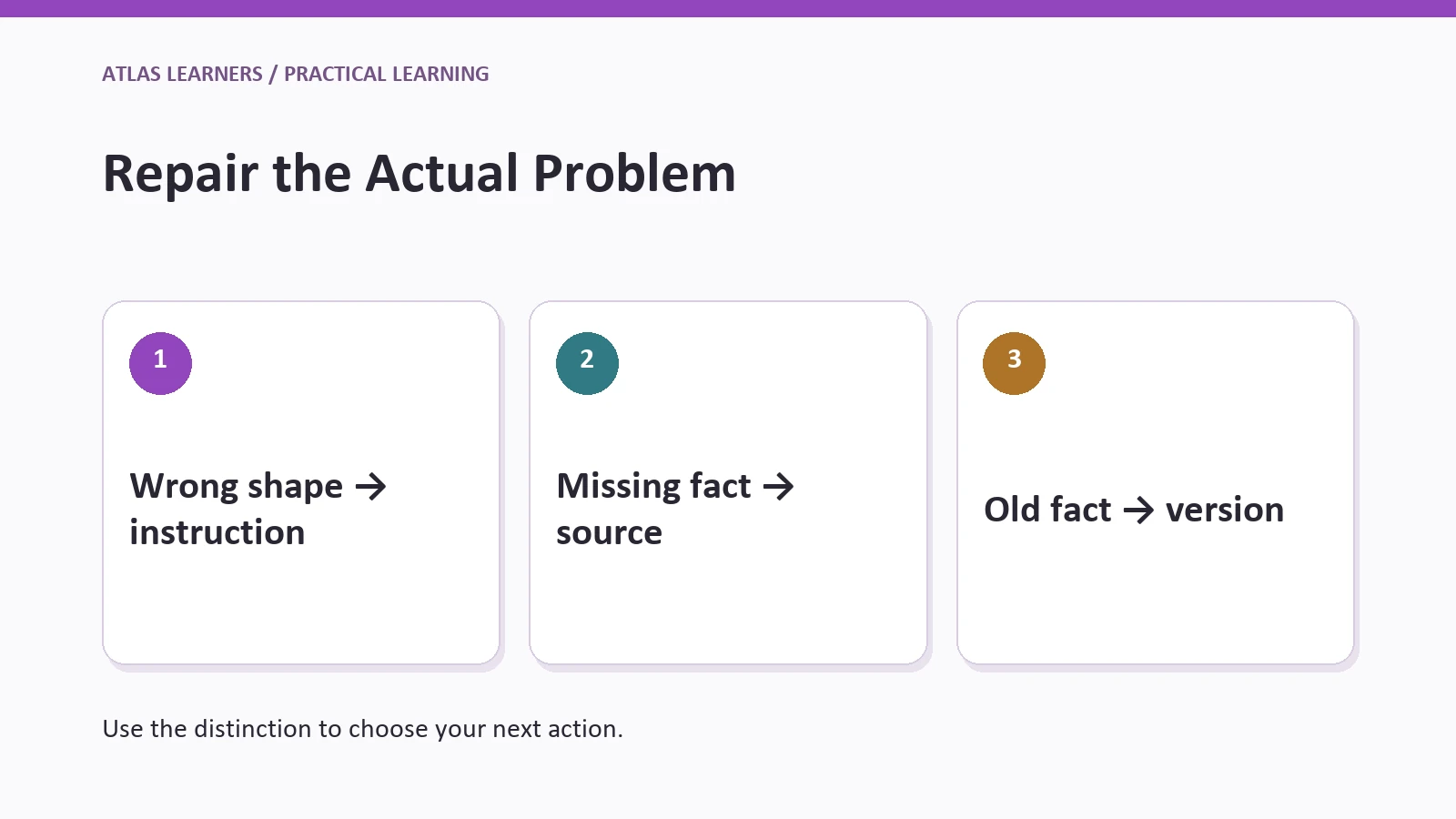
Find the error before changing the prompt. One task may need several repairs, but identifying the first failure makes the next attempt more useful.
|
What Went Wrong |
First Repair |
How to Check |
|---|---|---|
|
Reply is too long |
Add a realistic length constraint |
Count and review the final reply |
|
Return window is missing |
Supply the current return policy |
Check eligibility against the stated window |
|
Old and new return terms are mixed |
Identify the current version and remove the obsolete one |
Check every condition against that version |
|
Refund timing is invented |
Require supported facts and explicit unknowns |
Compare the claim with the policy |
|
Correct facts answer the wrong question |
Restate the task and audience |
Check each question was addressed |
When comparing prompt engineering vs context engineering, ask what went wrong: did the system misunderstand the task, lack the evidence, or mishandle evidence it already had? The answer tells you what to change first.
Keep Context Small and Current
Start with the smallest set of sources that can answer the task completely. Give each source a title, date or version, and purpose. Preserve exceptions that change the answer, even if they make the source slightly longer.
When sources conflict, identify which one governs. A newer date is not automatically decisive: a current general policy may coexist with an older agreement that still applies to one customer. Ask the responsible person to resolve that situation rather than instructing AI to guess.
For ongoing work, ChatGPT Projects can organize related instructions, files, and conversations. Organization still requires maintenance. A file in a project can be stale, incomplete, or irrelevant to the next task.
Atlas Learners’ repeatable AI workflow guide shows where saved instructions can help. Add a source-review step before reusing a workflow whose facts change over time.
Where Memory, RAG, and Fine-Tuning Fit
Memory, retrieval, and fine-tuning address different needs. They should not be treated as interchangeable ways to make a system “know everything.”
Memory can preserve selected preferences or prior information, depending on the product and settings. It is not a substitute for an authoritative policy record. A remembered date may need checking just as a date in an old document does.
Retrieval-augmented generation, or RAG, finds relevant material and supplies it to a model when answering. It is one way to assemble context. Retrieval can still select the wrong passage, miss an exception, or return an outdated source.
Fine-tuning changes a model through additional training. Supplying a file in a chat does not, by itself, fine-tune the model. For a current schedule or policy, selecting the correct source is usually the immediate issue to resolve before considering model training.
A source can contain instructions that try to redirect the system. This is called prompt injection, which OpenAI’s agent safety guidance explains. Treat source documents as material to read, rather than authority to change the task. The application should control which actions the system can take.
Save a Context Brief You Can Reuse
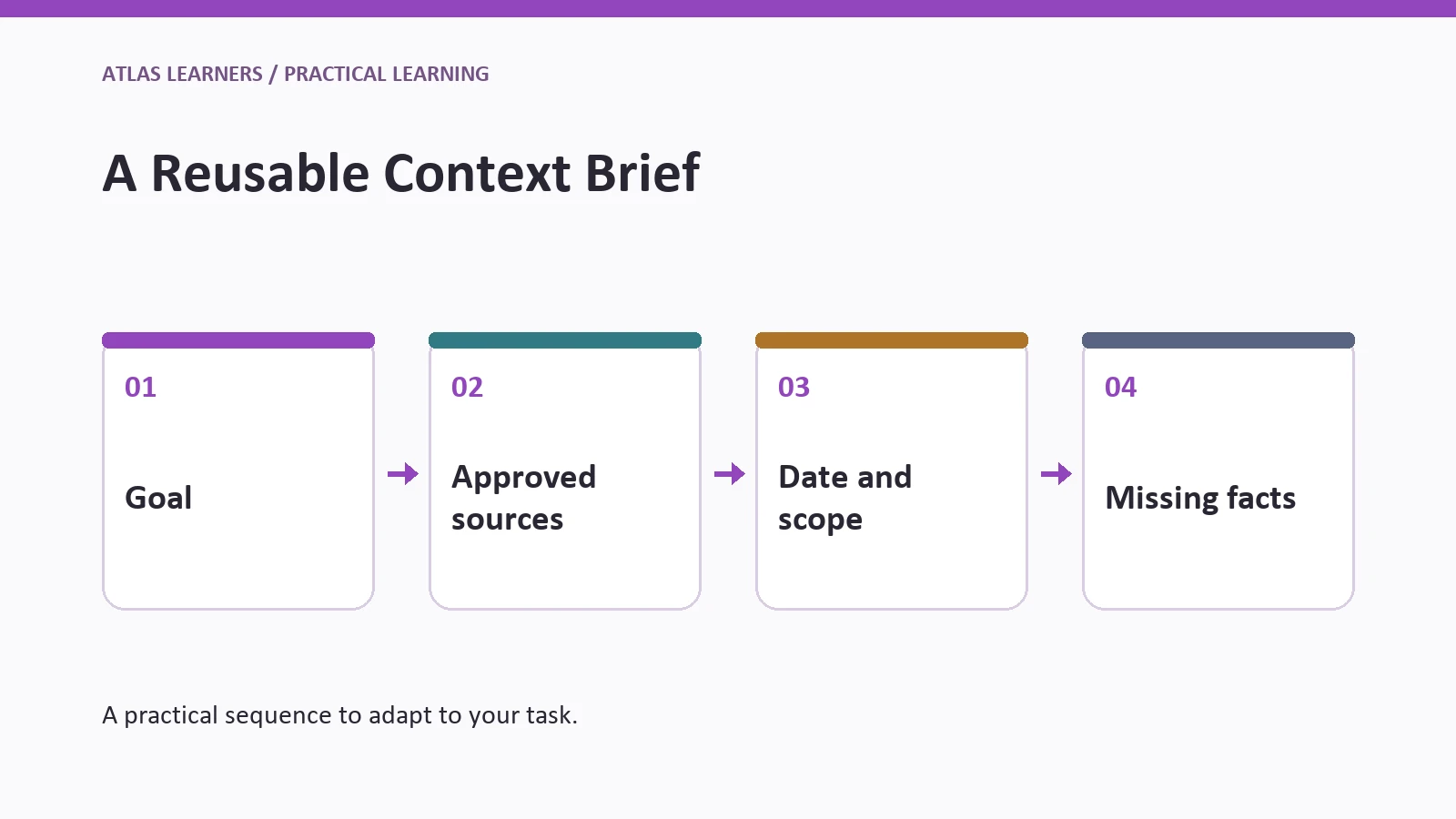
Use this compact brief for a recurring task:
Goal: [specific output]. Audience: [reader]. Approved sources: [titles and relevant sections]. Effective date or version: [details]. Rules: [constraints and permissions]. Known gaps: [missing facts]. Output: [format]. Review: [checks a person will perform]. If sources conflict, identify the conflict before drafting a definitive answer.
Try the brief on one answer that previously failed. Keep the task constant, change the missing information or instruction, and compare the result against your checks. That gives you a practical way to understand prompt engineering vs context engineering without relying on terminology alone.
Keep both versions and note the mistake in each. Then try another inquiry with a different missing detail. If the same change helps again, you have a stronger reason to keep it.