
ChatGPT prompts for students are most useful when they make you explain, remember, and apply what you are learning. Use AI to ask better questions and respond to your attempts, then check its answers against your course materials.
The 25 prompts below cover different learning problems, from understanding a difficult concept to planning exam review. If you need help setting out instructions, start with Atlas Learners’ four-part prompting guide.
Choose a Prompt for the Learning Problem
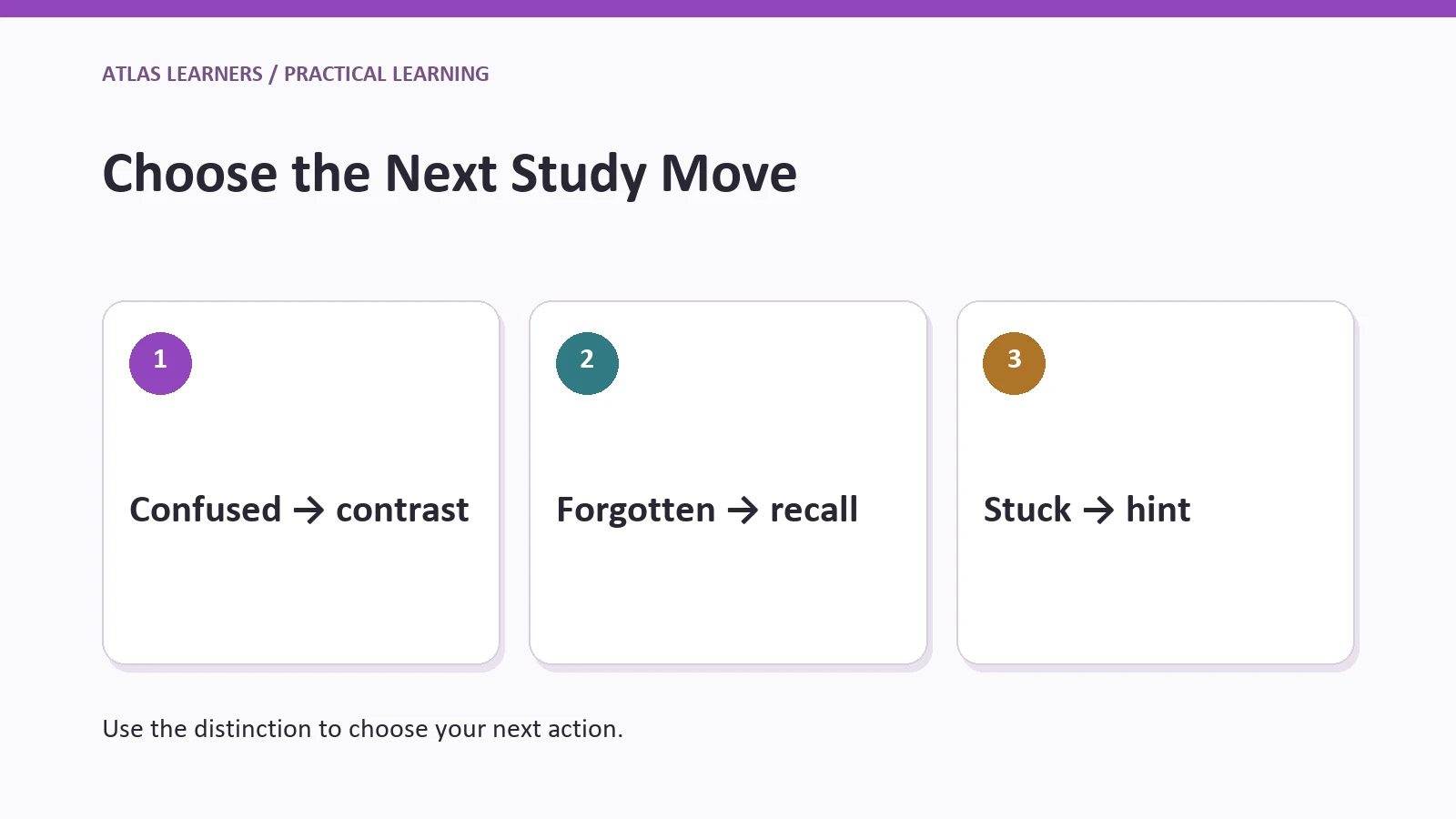
Choose the activity you need before choosing the wording. A clear explanation helps when a topic is unfamiliar; a closed-book question helps when you recognize the material but cannot recall it.
|
Your Problem |
Start With |
What to Do Yourself |
|---|---|---|
|
I cannot explain the idea |
Prompts 1–5 |
Restate it and give your own example |
|
I forget it without notes |
Prompts 6–10 |
Answer before revealing the explanation |
|
I know the rule but cannot use it |
Prompts 11–15 |
Solve a new case and explain your choice |
|
My notes are hard to revise |
Prompts 16–20 |
Turn the organized material into a test |
|
I need a realistic review plan |
Prompts 21–25 |
Adjust it using errors and available time |
In a 2013 review of 10 learning techniques, Dunlosky and colleagues rated practice testing and spaced practice highly. Summarization received a lower overall rating. So use summaries to prepare for practice, then check what you can explain without them. The review studied learning techniques, not these AI prompts.
Set Up ChatGPT Prompts for Students
Give ChatGPT a short, relevant source and a clear learning boundary. Replace the bracketed fields in this starter instruction, then add one numbered prompt below.
I am studying [subject] at [level]. Use the material below as the reference for this session. If it does not support an answer, say what is missing. Ask one question at a time and wait for my attempt. Give a hint before a full explanation. Material: [paste permitted notes or a short excerpt].
OpenAI’s Study Mode guidance describes questioning, hints, and checks of understanding. You can use those features when available, or request a similar conversational pattern in a regular chat. Neither option removes the need to check accuracy.
Understand Difficult Concepts
Use these AI prompts for studying when you need to make sense of an idea before testing yourself. After an explanation, close it and explain the idea in your own words.
1. Explain an Idea in Layers
Explain [concept] using my notes. Start with a plain-language explanation, then add the technical terms I need. Ask me to restate the idea before moving on.
This makes unfamiliar vocabulary easier to connect to an idea you can already describe.
2. Compare Two Similar Concepts
Compare [concept A] and [concept B] using the supplied material. Give one important difference and one example of each. Then give me a new case to classify.
Use this when two definitions feel interchangeable until you meet a question about them.
3. Find the Gap in My Explanation
Here is my explanation of [concept]: [attempt]. Compare it with my notes. Identify the first missing or incorrect idea and ask a question that helps me repair it.
You supply the explanation first, so the feedback responds to your thinking.
4. Connect an Abstract Idea to an Example
Give a simple example of [concept] that matches my notes. Explain which details make it an example. Then ask me to create a different example.
Check that the second example follows the rule, rather than copying the first one’s surface details.
5. Explain Where an Analogy Breaks
Explain [concept] with a familiar analogy. State where the analogy stops being accurate. Ask me to explain the concept without the analogy afterward.
An analogy is useful only while you can distinguish it from the actual idea.
Practice Active Recall
Active recall means bringing information to mind without looking at the answer. These ChatGPT study prompts make that effort part of the interaction.
In Roediger and Karpicke’s 2006 passage-learning experiment, students who took an initial recall test remembered 56% of the passage’s ideas a week later, compared with 42% among those who studied it again. This was a test of recall practice, not ChatGPT. Use the assistant to ask the questions while you do the remembering.
6. Quiz Me One Question at a Time
Ask one short-answer question from my notes. Wait for my answer. Check it against the source, explain any gap, and ask a different question about the same idea if I miss it.
7. Make Flashcards With One Clear Target
Create 8 flashcards from my notes, with one concept per card and a source heading for each answer. Avoid vague questions. Show the questions first and keep answers separate.
Review the cards before using them. A memorized error is still an error.
8. Test a Blank-Page Recall Attempt
I recalled this topic without my notes: [attempt]. Compare it with the source. Separate correct points, missing points, and misconceptions. Ask me to repair one misconception first.
9. Ask for a Definition and an Example
Ask me to define [term] and give an example. Evaluate those separately against the notes. Do not count a memorized definition as a complete answer if my example is wrong.
10. Revisit an Earlier Error
Earlier I confused [idea] with [idea]. Ask a new question that tests the distinction without repeating the old wording. Wait for my response before explaining.
Save the missed concept, not just the original question. Otherwise you may learn the answer’s wording without learning the distinction.
Explain and Apply What You Know
Application questions reveal whether you can use an idea beyond the example you first studied. The IES study guide recommends deep explanatory questions alongside other learning activities.
11. Ask Me Why a Step Works
Show a short worked example of [method] using my course conventions. Pause at one step and ask why that step is valid. Give feedback after I answer.
12. Give a Hint Without Finishing the Problem
I am stuck here: [problem and attempt]. Give the smallest hint that helps with my next step. Do not solve the whole problem unless I ask after another attempt.
13. Change One Condition
Take this example: [example]. Change one important condition and ask how the answer changes. Keep the difficulty close to my course level and explain only after my attempt.
14. Ask Me to Choose a Method
Give a new problem that could tempt me to use the wrong method. Ask which method I would choose and why. Check my reasoning against the supplied material.
15. Run a Short Oral Practice Session
Ask 3 follow-up questions about [topic], one at a time. Make the next question respond to my previous answer. Ask for explanations, not just definitions, and note gaps at the end.
For a graded assignment, use an instructor-approved practice problem rather than asking AI to complete the submitted task.
Turn Notes Into Useful Review Material
Organized notes make practice easier to prepare. The learning still depends on what you do with them.
16. Turn Headings Into Questions
Turn each heading in my notes into a question I should be able to answer. Keep the original heading beside it. Flag headings with too little information for a fair question.
17. Summarize and Then Test
Summarize the main argument in 5 sentences without adding claims. Then give 3 questions that require me to reconstruct the argument without looking at the summary.
18. Build a Concept Relationship Map
List the important concepts in these notes and explain how each connects to another. Use only supported relationships. Leave one connection blank for me to explain.
19. Identify Missing Information
Compare these notes with the supplied learning objectives. Show which objectives have supporting material and which need more notes. Do not fill gaps from memory.
20. Make a Mistake Log
Organize these checked mistakes into concept, my error, correction, and next practice question. Preserve my wording where it reveals the misunderstanding. Do not invent a score.
Plan and Adjust Exam Preparation
Use prompts for exam preparation to distribute practice within the time you actually have. A schedule should respond to what you miss, not simply cover every chapter once.
21. Start From the Exam Requirements
Use this syllabus and exam format to identify the skills I need to demonstrate. Separate factual recall, explanation, and problem solving. Flag anything the documents do not specify.
22. Fit Review Into a Fixed Budget
I have [days] and [minutes each day]. Plan review for [topics]. Include unaided questions, checking, and revisiting mistakes. Show daily totals and stay within my available time.
23. Schedule Spaced Review
Create a starting review schedule for these topics before [date]. Revisit earlier material on later days. Explain how I should adjust the schedule if recall is weak or strong.
There is no universal spacing interval that fits every subject and deadline.
24. Build a Mixed Practice Set
Create 6 questions mixing these methods: [list]. Do not label which method each question needs. Put the checked answer key separately and identify the supporting source sections.
25. Revise the Plan After a Check
Here are my checked results and available time: [details]. Revise the next 2 sessions around the gaps. Keep successful topics in brief review and explain what you removed to make room.
A Hypothetical Study Session From Start to Revision
Suppose you are learning correlation and causation. Your permitted notes say: “A positive association means two variables tend to increase together. It does not establish that one causes the other. A third factor may affect both.”
You use prompt 6. An illustrative question is: “Ice cream sales and swimming activity rise together. Does this prove that buying ice cream causes swimming?” Your first answer says yes because both increase.
A useful correction points to the notes and asks what else could affect both. You suggest warm weather, then revise: “The pattern shows an association. Weather could influence both, so this observation alone does not show that one causes the other.”
The next question should use different variables. That checks whether you learned the distinction rather than memorized the ice cream example. Matching an assessment to the learning objective also matters: recognizing a definition cannot fully assess your ability to explain a new case.
Check Answers and Follow Your Course Rules
Verify generated questions and corrections against course materials, especially formulas, dates, quotations, and disputed interpretations. If the source does not settle a point, ask your instructor or consult an approved reference before practicing it repeatedly.
Yale’s student guidance emphasizes preserving the intellectual work required for learning. Follow your own course’s AI policy, keep your attempts, and disclose assistance when required. Permission to use a chatbot does not automatically include permission to upload classmates’ work or restricted teaching material.
For the broader limits of generated answers, see Atlas Learners’ generative AI introduction. Our everyday AI task guide covers organizing study material and other repeatable tasks.
Try One Recall Cycle Today
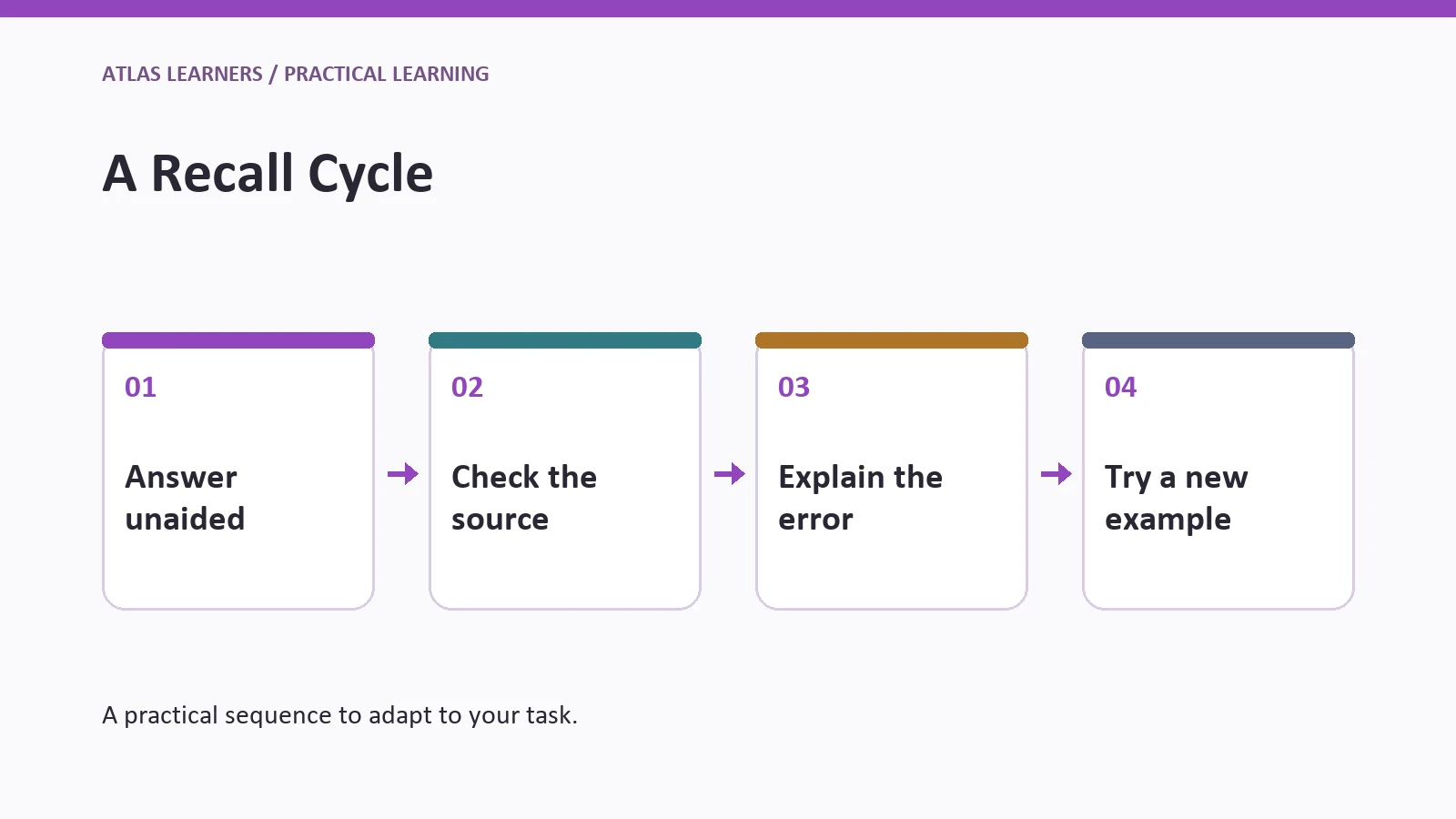
Choose one concept and use prompt 6 before reading another summary. Answer from memory, check the source, record the error, and try a new example later.
Keep the ChatGPT prompts for students that make you do useful thinking. Save your strongest prompt using the structure in the Atlas prompting guide, so your next study session starts with practice.